A Kansas Program Is Helping People Leave Prison With a $100K Truck Driving Career
Right now, inside two Kansas prisons, eight people are training for work that can pay close to $100,000 a year. No four-year degree. No student debt. Four weeks of CDL training, and a license in their hand the day they walk out.
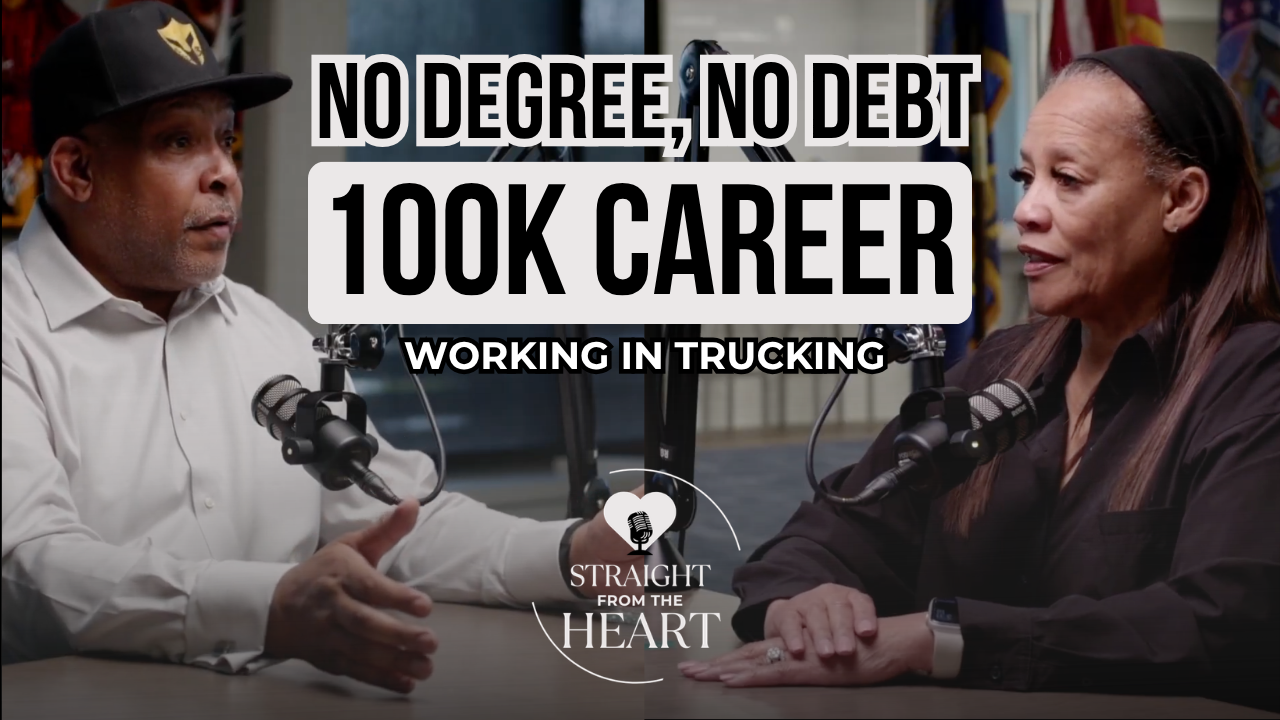
On Episode 26 of Straight From The Heart, Harold Fears came back to talk about what’s happening at Ares CDL Institute right now. The last time he joined the show, on Episode 12, most of this was still a plan. It isn’t a plan anymore. It’s running.
1. “None of us are trash”
Fears sees a second chance as a basic question about who we are as a community.
“We all need second chances and we all need first chances. We are all human beings. None of us are trash. Some of us made mistakes and those people are coming out and being part of our community.”
If we expect people to come home and be productive citizens, we owe them a real shot at productive work. The data agrees: people who hold steady work in their first year out are far less likely to return to prison than those who can’t find a job, 16% versus 52% by the U.S. Chamber’s count.
For employers, the upside isn’t only moral, either. Hiring on skill instead of stigma can come with real savings, including the federal Work Opportunity Tax Credit. When someone argues these six-figure jobs should be reserved for people who never went to prison, Fears has a fast answer. “They are preserved for those,” he said. “They just don’t want to take the opportunity to do them.”
2. What’s actually running right now
Through a partnership with the Kansas Department of Corrections, Fears has started teaching inside the walls. He’s at Lansing, the men’s facility, on Mondays, Wednesdays and Fridays, and at Topeka Correctional Facility, the women’s prison, on Tuesdays and Thursdays. Eight students are enrolled so far: five men and three women.
The driving is what sets it apart. “This will be the first program in the United States that will allow residents to drive while they’re incarcerated,” Fears said. Most programs get someone up to a permit and stop there. Ares graduates walk out with an actual CDL. And the school is built to do more than hand someone a license, with a reputation for wrapping students in support like meals, transportation, and job placement.
For students releasing in June and August, the state approved what Fears calls “train release.” He picks them up at Lansing, brings them to his Kansas City, Kansas facility, trains them, and returns them. A few other states are trying versions of this, but only to the permit stage. Kansas took it further.
3. Four weeks, no debt, six figures
The math is the part that stops people. Four weeks of training. Within a year, a driver can be earning around $100,000. And trucking isn’t one narrow lane. Local, regional, over the road, flatbed, hazmat, even white-glove freight work moving medical products and fine art. The skill travels, and the need for drivers isn’t slowing down, with hundreds of thousands of openings projected every year.
Fears doesn’t soften the comparison for families who put all their hope in a diploma. Someone can spend ten years in school and top out around $150,000. One of his students can train in weeks and, within a year, “be able to live right next to you. Cause he can afford it.”
This isn’t only for people coming home, either. An 18-year-old out of high school can earn a CDL and drive within Kansas, though federal rules still keep drivers under 21 from crossing state lines. A college student can get licensed over a summer and drive weekends for real money, since the license doesn’t expire. The same thing already happens across rural Kansas, where young people walk out of high school into skilled trades at $70,000 and up with no debt. Not every kid is college bound, and we don’t talk about those doors enough. Anyone ready to get started, coming home or straight out of high school, can enroll through Ares CDL Institute directly.
4. Ownership, not just a job
A job is good. Owning the thing is better. That’s why the “Ares Promise” matters: if a driver shows the skills and the business sense, Ares will help them become a truck owner. It’s a path from the cab to the title.
Fears isn’t stopping there. His goal is a trucking company staffed entirely by people coming home. “I don’t plan to hire anybody that doesn’t have a criminal background,” he said. He’s also thinking about the wall that trips up almost everybody after release, which is housing. His business partner, Stacy Landis of Property Plus Construction, is drawing up housing that will actually rent to returning citizens, including affordable units and a place graduates can stay until they’re settled into a job. An address is the difference between an application and an offer.
5. “Showing up is half the battle”
If you’ve ever felt like a one-man band trying to build something that matters, this part will sound familiar. Fears doesn’t have a million-dollar ad budget, so he knocks on doors and sends emails on Saturdays and Sundays. “When I wake up at three o’clock in the morning, I do my little social media thing to get the word out,” he said. “And I just keep showing up. And that’s half the battle.”
He’s still fighting the Kansas-Missouri border, too. His school sits on the Kansas side, but 90% of his students come from Missouri, and the Missouri paperwork can run eight to ten months behind. Most small businesses can’t wait ten months on a form, so he finds the work-arounds and keeps moving. “I love the struggle. I love the fight. It’s fun for me.”
He also made a point of naming the person who helped him early: Mary Ricketts of Turning Point, an HBCC member who mentored and connected Ares when it was still finding its footing, and never charged a dime. That’s how we win. We support one another.
The work is already moving
Harold Fears isn’t waiting for permission or a perfect plan. He’s putting CDLs in people’s hands before they leave prison, building toward ownership, and lining up the housing and jobs that make a second chance stick. The full story, in his own words, is worth your time.
Hear the whole conversation with Harold Fears on Episode 26 of Straight From The Heart, streaming now on YouTube, Spotify, and Apple Podcasts.
Frequently Asked Questions
Can someone with a felony get a CDL?
In most cases, yes. A criminal record by itself doesn’t disqualify someone from earning a commercial driver’s license. There are limits, certain serious offenses, like using a commercial vehicle to commit a felony involving drugs, can trigger a federal disqualification, and some hazmat endorsements have tighter rules. But for most people coming home, a CDL is very much on the table, which is exactly the door Ares CDL Institute is opening.
Do you need a college degree to become a truck driver?
No. You don’t need a two- or four-year degree to drive a truck. What you need is a CDL, which comes from a focused training program measured in weeks, not years. That’s a big part of why this path appeals to people who want strong earnings without taking on student debt.
How long does CDL training take?
Weeks, not years. The Ares program Harold Fears describes runs about four weeks, and full Class A courses commonly run four to seven weeks depending on the school and schedule. Compare that to the decade some careers ask for before the pay catches up.
Can you really make $100,000 a year driving a truck?
It’s realistic for some drivers, though not guaranteed for everyone. Federal data puts median pay for heavy and tractor-trailer drivers around $57,000, but specialized hauling, long-haul routes, and especially truck ownership push experienced drivers toward and past six figures within a year or two. Getting drivers onto that higher track, and eventually into ownership, is the whole point of the “Ares Promise.”
Can you earn a CDL while you’re still in prison?
In Kansas, now yes. Through a partnership with the Kansas Department of Corrections, Ares CDL Institute is running what Harold Fears says is the first program in the country to let residents earn an actual CDL while incarcerated, not just a permit. Students train through a “train release” arrangement and can walk out ready to work.
How old do you have to be to get a CDL in Kansas?
You can earn a CDL at 18 and drive within Kansas. Federal rules still require drivers to be 21 to cross state lines, so an 18-to-20-year-old is limited to in-state routes for now. For a young person straight out of high school, that’s still a real career with real money attached.
How do I enroll in Ares CDL Institute?
Start at acdli.org or call 913-207-8841. The students currently training inside Kansas facilities are supported by scholarships, and Ares can walk anyone else through current tuition, schedules, and the enrollment steps. Whether you’re coming home or just out of high school, the first move is reaching out.